


12:10 – 1:00 pm, Presbyterian Parish House
Gabe Henry
Gabe Henry is the author of three books, including the poetry anthology Eating Salad Drunk, a humor collaboration with Jerry Seinfeld, Bob Odenkirk, Mike Birbiglia, Margaret Cho, and other titans of comedy. Eating Salad Drunk was featured in The New Yorker in February 2022 (“A Smattering of Haiku for the Burnout Age”) and ranked one of Vulture’s Best Comedy Books of 2022.
Henry’s work has been published in TIME, New York Magazine, The New Yorker, The Weekly Humorist, US News & World Report, and more. He has spent more than a decade exploring the strange and forgotten history of simplified spelling, which, by his own admission, has only made him a worse speller. He lives and works in New York.
MFOB featured book: Enough Is Enuf: Our Failed Attempts to Make English Easier to Spell
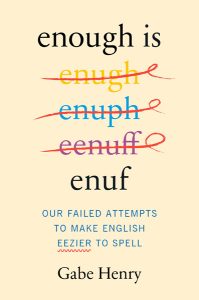 Why does the G in George sound different from the G in gorge? Why does C begin both case and cease? And why is it funny when a phonologist falls, but not polight to laf about it?
Anyone who has the misfortune to write in English will, every now and then, struggle with its spelling. According to a study in the British Journal of Psychology, children take two to three times longer to grasp English spelling compared to more phonetic orthographies like German and Spanish.
So why do we continue to use it? If our system of writing words is so tragically inconsistent, why haven’t we standardized it, phoneticized it, brought it into line? How many brave linguists have ever had the courage to state, in a declaration of phonetic revolt: “Enough is enuf”?
The answer: many. In the comic annals of linguistic history, legions of rebel wordsmiths have died on the hill of spelling reform, risking their reputations to bring English into the realm of the rational.
Enough Is Enuf: Our Failed Attempts to Make English Easier to Spell is about them: Noah Webster, Theodore Roosevelt, Mark Twain, Ben Franklin, Eliza Burnz, C. S. Lewis, George Bernard Shaw, Charles Darwin, and the innumerable others on both sides of the Atlantic who, for a time in their life, became fanatically occupied with writing thru instead of through, tho for though, laf for laugh, beleev for believe, and dawter for daughter (and tried futilely to get everyone around them to do it, too).
Henry takes his humorous and informative chronicle right up to today as the language seems to naturally be simplifying to fit the needs of our changing world thanks to technology—from texting to Twitter and emojis, the Simplified Spelling Movement may finally be having its day.


